

Growing Alphonso Mango on Konkan Laterites, Maharashtra
Abstract
Laterites are infamous for not allowing a single blade of grass to grow on it. Konkan, Maharashtra has a sizable area under laterites due to exposure of red soils over time to convert it into a chunk as hard as rock. These areas locally known as jambha katal are usually kept fallow. However, some of these areas have profitably been utilized for Alphonso mango cultivation using the techniques of Dr. Balasaheb Sawant Konkan Krishi Vidyapeeth (DBSKKV), Dapoli, Maharashtra, using the wisdom of local farmers.
This results in two-fold benefits namely, expansion of cultivable area in mango and profitable use of otherwise fallow lands. The present article details the technique of hard rock Alphonso mango planting in Konkan, Maharashtra. Using basic and fundamental data on natural resources, it also explores the mystery behind the successful endeavour for profitable and economically feasible mango cultivation on otherwise wastelands.
Introduction
Spatially-associated red (Alfisols) and black (Vertisols and their intergrades; Soil Survey Staff, 2014) soils as distinct entities are common in the Western Ghats and in Konkan, Maharashtra (Bhattacharyya et al., 2018). These soils are often referred to as laterites (Sahasrabudhe and Deshmukh, 1981).
The terms ‘red’ and ‘laterite’ have led to controversial opinions. Contrary to general belief that such soils are difficult on which to grow crops (Aleva, 1994), these associated soils in Konkan are cultivated profitably to various agricultural and horticultural crops besides forestry with appropriate conservation measures (Bhattacharyya et al., 1992, 1999, 2014).
Out of many horticultural crops, Alphonso variety of mango is one of the most popular and preferred crop for planting in Konkan, Maharashtra grown on many occasions on these associated soils often referred as laterites.
Area of the Study
Konkan, Maharashtra covers an area of nearly 3.0 million hectares and represents a coastline of 720 km stretching south of Gujarat to north of Goa. The basaltic terrain receives rainfall averaging 2500–4000 mm.
North Konkan comprising Raigad, Thane and Palghar bears similarity with basaltic landscapes of central Maharashtra due to lower elevation and wider landmass. Southern Konkan narrows towards Goa and represents undulating landscapes with steep slopes causing soil erosion and formation of lateritic hard rock (jambha katal).
Out of 49% agricultural land in Konkan, 72% is under crops and the rest is fallow (Doke, 2017). Forest area accounts for 44%, including dense forest (42%), open forest (20%), and shrubs (38%). Laterites are commonly used as building materials though mango plantation can be an alternative land use.
Alphonso Mango in Konkan, Maharashtra
Mango is a tropical fruit and can be grown up to 1100 m above mean sea level. Ideal temperature ranges from 24–27°C. It grows best in regions receiving about 2500 mm rainfall. High humidity and rain or frost during flowering are detrimental. Bright sunshine and moderate humidity are ideal for fruit development.
Mango is an important rainfed perennial fruit crop in Konkan. Government initiatives since 1990 increased Alphonso mango cultivation to 1,64,000 ha. Out of this, 1,11,715 ha is productive producing 3,53,066 tonnes of fruits.
Average productivity of Alphonso mango is 3.8 t/ha, lower than state (5.0 t/ha) and national (8.5 t/ha) averages. Neglect of orchards due to absentee landlords is a major reason for low productivity.
Land Availability and Hard Rock Mango Cultivation
Limited availability of productive land restricts mango plantation expansion. Fragmented land ownership and absentee landlords result in fallow land. Areas near Sahyadri hills and beyond 20 km from the coast are unsuitable due to late flowering.
Hard rock lateritic lands near the sea favour early flowering and premium-quality fruits. Farmers observed natural mango growth in rock cracks, leading to adoption of hard-rock planting techniques using blasting, drilling, and mechanization.
Approximately 3 lakh hectares of hard rock land remains fallow in Konkan. Mango grown in such areas fetches premium prices domestically and internationally.
Characteristics of Alphonso Mango Grown in Konkan
Parameter | Value |
Fruit shape | Oblong |
Fruit length | 8.5–11.2 cm |
Fruit weight | 200–300 g |
Skin thickness | Thin |
Mature skin colour | Yellow |
TSS | 17.2–19.5 °B |
Acidity | 0.20–0.35% |
Pulp | 70–87% |
Pulp colour | Yellow-orange |
Fibre | Absent |
Taste | Sweet, pleasant |
Ripening | 6–10 days |
Post-harvest life | 18–28 days |
Technique of Hard Rock Mango Planting
- Layout and blasting for rock fracturing
- Excavated rock unsuitable for planting
- Good-quality poyta soil procured (≈1 brass per pit)
- Excavated material used to build raised mounds
- Around 20–25 thousand hectares planted using this method.
Factors Affecting Success
- Type of rock
- Crack formation in pit walls and base
- Pit volume (75–100 cubic feet)
- Quality and quantity of refill soil
- Canopy management
Improper blasting can cause water stagnation, excessive heat (up to 50°C), and tree mortality.
Selected Soil Properties (Devgad, Sindhudurg)
Sample | pH | Sand % | Silt % | Clay % | Ca | Mg | CEC | Base Saturation |
1 | 5.6 | 28 | 52 | 21 | 9.2 | 4.1 | 20.0 | 73 |
2 | 5.3 | 17 | 48 | 36 | 2.8 | 1.4 | 18.0 | 33 |
Yield and Monetary Returns
Year | Yield (t/ha) | Returns (₹/ha) |
5th | 0.5 | 20,000 |
6th | 1.0 | 40,000 |
7th | 1.5 | 60,000 |
8th | 2.0 | 80,000 |
9th | 3.0 | 1,20,000 |
10th | 4.0 | 1,60,000 |
11th onwards | 5.0 | 2,00,000 |
Total | — | 8,80,000 |
References
Aleva, G.J.J. (Compiler). 1994. Laterites, Concepts, Geology, Morphology and Chemistry, pp. 1–169. ISRIC, Wageningen.
Anonymous. 2018. Report of Maharashtra State Agriculture Marketing Board (MSAMB). Govt. of Maharashtra.
Bhattacharyya, T., Patil, K.D., Kasture, M., Salvi, B.R., Dusani, A., Patil, V.K. and Haldankar, P.M. 2018. Mango-growing soils and their characteristics. In A Resource Book on Mango (B.R. Salvi et al., Eds.), pp. 71–98. DBSKKV, Dapoli, Maharashtra.
Bhattacharyya, T., Mandal, C. and Deshmukh, S.N. 1992. Soils and land use patterns in part of Western Maharashtra. Journal of the Indian Society of Soil Science 40: 513–520.
Bhattacharyya, T., Pal, D.K. and Srivastava, P. 1999. Role of zeolites in persistence of high altitude ferruginous Alfisols of the Western Ghats, India. Geoderma 90: 263–276.
Bhattacharyya, T., Pal, D.K., Lal, S., Chandran, P. and Ray, S.K. 2006. Formation and persistence of Mollisols on zeolitic Deccan basalt of humid tropical India. Geoderma 136: 609–620.
Bhattacharyya, T., Pal, D.K., Gupta, R.K., Chandran, P., Ray, S.K., Mandal, C., Jagdish Prasad, Sarkar, D., Tiwary, P., Karthikeyan, K. and Telpande, B. 2014. Prioritizing areas for soil carbon sequestration: a step for conservation agriculture. In Conservation Agriculture – An Indian Perspective (Soma Sundaram et al., Eds.), pp. 225–246. New India Publishing Agency (NIPA).
Bhattacharyya, T., Patil, K.D., Kasture, M.C., Salvi, B.R., Dosani, A., Patil, V.K. and Haldankar, P.M. 2018. Mango-growing soils and their characteristics. In Advances in Mango Production Technology (B.R. Salvi et al., Eds.), pp. 71–98. Dr. Balasaheb Sawant Konkan Krishi Vidyapeeth, Dapoli.
Burondkar, M.M., Shailendra, Rajan, Upreti, K.K., Reddy, Y.T.N., Singh, V.K., Sabale, S.N., Naik, M.M., Nigade, P.M. and Saxena, Pooja. 2013. Advancing Alphonso mango harvest season in lateritic rocky soils of Konkani region through manipulation in time of paclobutrazol application. Journal of Applied Horticulture 15: 178–182.
Doke, A.B. 2017. Land use/cover mapping of Konkan region, Maharashtra. International Journal of Current Research Review 9: 1–6.
Pascoe, E.H. 1964. A Manual of the Geology of India and Burma, Volume III, Third Edition.
Sahasrabudhe, Y.S. and Deshmukh, S.S. 1981. Laterites of the Maharashtra State. In Proceedings of the International Seminar on Laterisation Processes, IGCP Project 129, pp. 209–220. A.A. Balkema, Rotterdam.
Salvi, B.R., Chavan, S.A., Dalvi, N.V. and Shinde, V.V. 2009. Hard Rock Mango Plantation, pp. 1–42. Dr. Balasaheb Sawant Konkan Krishi Vidyapeeth, Dapoli, Maharashtra.
Salvi, B.R., Dalvi, N.V. and Munj, A.Y. 2016. AICRP Fruits Biennial Report 2007–2016. Dr. Balasaheb Sawant Konkan Krishi Vidyapeeth, Dapoli, Maharashtra.
Soil Survey Staff. 2014. Keys to Soil Taxonomy, 12th Edition, pp. 1–52. USDA–NRCS, Washington, DC.
Soubrand-Colin, M., Bril, H., Catherine, A., Courtin, N. and Martin, F. 2005. Weathering of basaltic rocks from the French Massif Central: origin and fate of Ni, Cr, Zn and Cu. Canadian Mineralogist 43: 1077–1091.
Srivastava, P., Bhattacharyya, T. and Pal, D.K. 2002. Significance of the formation of calcium carbonate minerals in the pedogenesis and management of cracking clay soils (Vertisols) of India. Clays and Clay Minerals 50: 111–126.
Abstract
Laterites are infamous for not allowing a single blade of grass to grow on it. Konkan, Maharashtra has a sizable area under laterites due to exposure of red soils over time to convert it into a chunk as hard as rock. These areas locally known as jambha katal are usually kept fallow. However, some of these areas have profitably been utilized for Alphonso mango cultivation using the techniques of Dr. Balasaheb Sawant Konkan Krishi Vidyapeeth (DBSKKV), Dapoli, Maharashtra, using the wisdom of local farmers. This results in two-fold benefits namely, expansion of cultivable area in mango and profitable use of otherwise fallow lands. The present article details the technique of hard rock Alphonso mango planting in Konkan, Maharashtra. Using basic and fundamental data on natural resources, it also explores the mystery behind the successful endeavour for profitable and economically feasible mango cultivation on otherwise wastelands. Key words: Hard rock, Alphonso mango, laterites, Konkan, Maharashtra
Introduction
Spatially-associated red (Alfisols) and black (Vertisols and their intergrades; Soil Survey Staff, 2014) soils as distinct entities are common in the Western Ghats and in Konkan, Maharashtra (Bhattacharyya et al, 2018). These soils are often referred to as laterites (Sahasrabudhe and Deshmukh, 1981). The terms ‘red’ and ‘laterite’ have led to controversial opinions. Contrary to general belief that such soils are difficult on which to grow crops (Aleva, 1994), these associated soils in Konkan are cultivated profitably to various agricultural and horticultural crops besides forestry with appropriate conservation measures (Bhattacharyya et al., 1992, 1999, 2014). Out of many horticultural crops, Alphonso variety of mango is one of the most popular and preferred crop for planting in Konkan, Maharashtra grown on many occasions on these associated soils often referred as laterites.
Area Of Study
As compared to other parts of Maharashtra and also
from India in terms of variation in geology, climate,
soils, and environment, Konkan, Maharashtra is
different. Konkan covers an area of nearly 3.0 million
hectares (Mha) and represents a coast line of 720
km stretching south of Gujarat to north of Goa. This
basaltic terrain receives a rainfall averaging 2500-
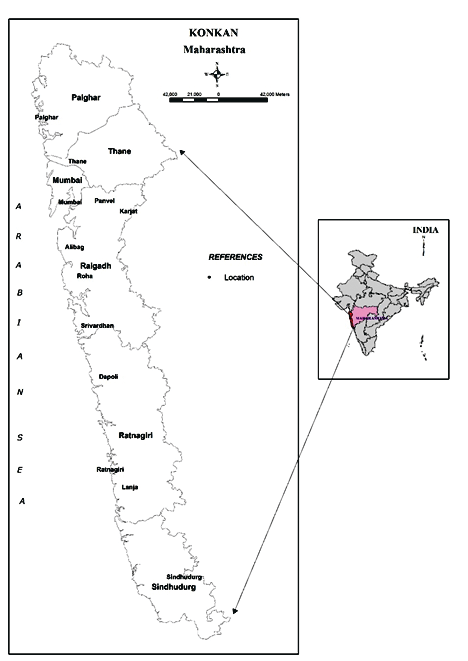
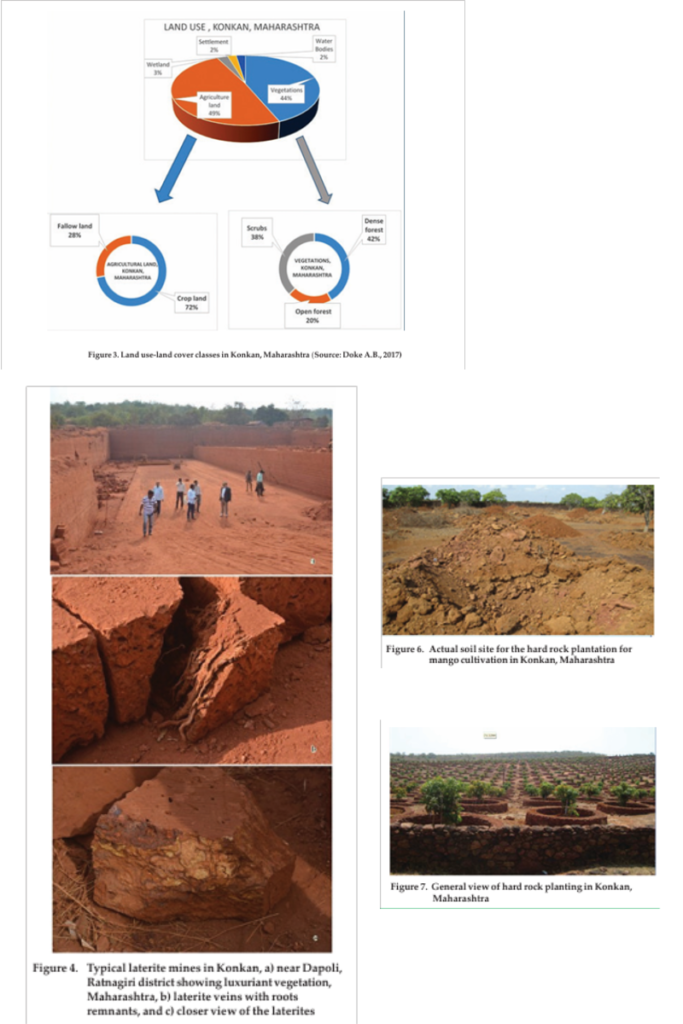
4000 mm. North Konkan comprising of part of Raigad, Thane and Palghar (Figure 2), bears some similarity of typical basaltic landscape like central Maharashtra and Vidarbha. This might be due to the fact that Palghar and Thane are on lower elevation and have more breadth (distance between Arabian sea and the Western Ghats) resulting in the formation and persistence of deep black soils as is common in other parts of Maharashtra. On the contrary, southern Konkan gradually narrows down south to Goa and represents undulating landscape with steep slopes causing severe soil erosion and at many places typical landscape commonly known as laterites or locally as jambha katal (hard rock). Out of 49% agricultural land in Konkan, Maharashtra, 72% is a land under crops while the rest is fallow (Doke, 2017; Figure 3). The 44% forest area consists of dense (42%) and open forest (20%); the shrubs constitute 38%. Typical laterites are used as building materials (Figure 4) where mango plantation could be an alternative land use practice.
Alphonso Mango in Konkan, Maharashtra
Mango is a tropical fruit, but can be grown up to 1100 m above mean sea level (amsl). The ideal temperature range for appropriate mango growth is between 24 to 27 oC. It can be grown best in regions with a rainfall of 2500 mm (250 cm). High humidity, and rain or frost during flowering are detrimental to mango cultivation. Higher temperature during fruit development and maturity gives better quality fruits. Regions with bright sunny days and moderate humidity during flowering and fruit development are ideal for growing mango (Anonymous 2017). Mango is an important rainfed perennial fruit crop of Konkan, Maharashtra. Various programmes implemented by Maharashtra Government since 1990 helped to speed up the plantation of Alphonso variety of mango; as a result, the area under mango cultivation increased up to 1,64,000 ha in Konkan region (Salvi et al., 2009). Out of this 1,11,715 ha area is productive and contributes 3,53,066 tonnes
(t) of fruits production (Anonymous, 2018). The
average productivity of Alphonso mango is 3.8 t
ha-1 which is much lower than that of the state (5.0
t ha-1) and national average (8.5 t ha-1). One of the
main reasons for low productivity of Alphonso
mango from Konkan region is that the orchards are
normally neglected because of most of the owners
being absentee land lords. There are several
progressive mango growers in the region who have
been harvesting more than 7.0 t ha-1 of Alphonso
mango.
Land Availability and Hard Rock Mango Cultivation
Availability of productive land in Konkan is the major limitation for many people to go in for Alphonso plantation. Though cultivable waste land suitable for mango plantation in Konkan region is available, it is mostly owned by many members of the family and most of them are absentee land lords. Therefore, such fragmented properties (land) remain fallow. In Konkan theland available near Sahyadri hills and away from the sea shore around 20 km are not suitable for mango plantation due to late flowering and subsequent late harvesting. So the availability of land for new plantation is a major problem. Even if some small holdings are available, those cannot be brought under cultivation due to family disputes. All these factors force the new entrepreneurs to go in for hard rock (laterites) plantation. The lateritic hard rock areas are nearby sea-coast and some of these pockets are directly exposed to the sea which favours very early flowering and development of excellent quality fruits to fetch premium market rates. Moreover, the quality of Alphonso mango grown in lateritic rock is also good.
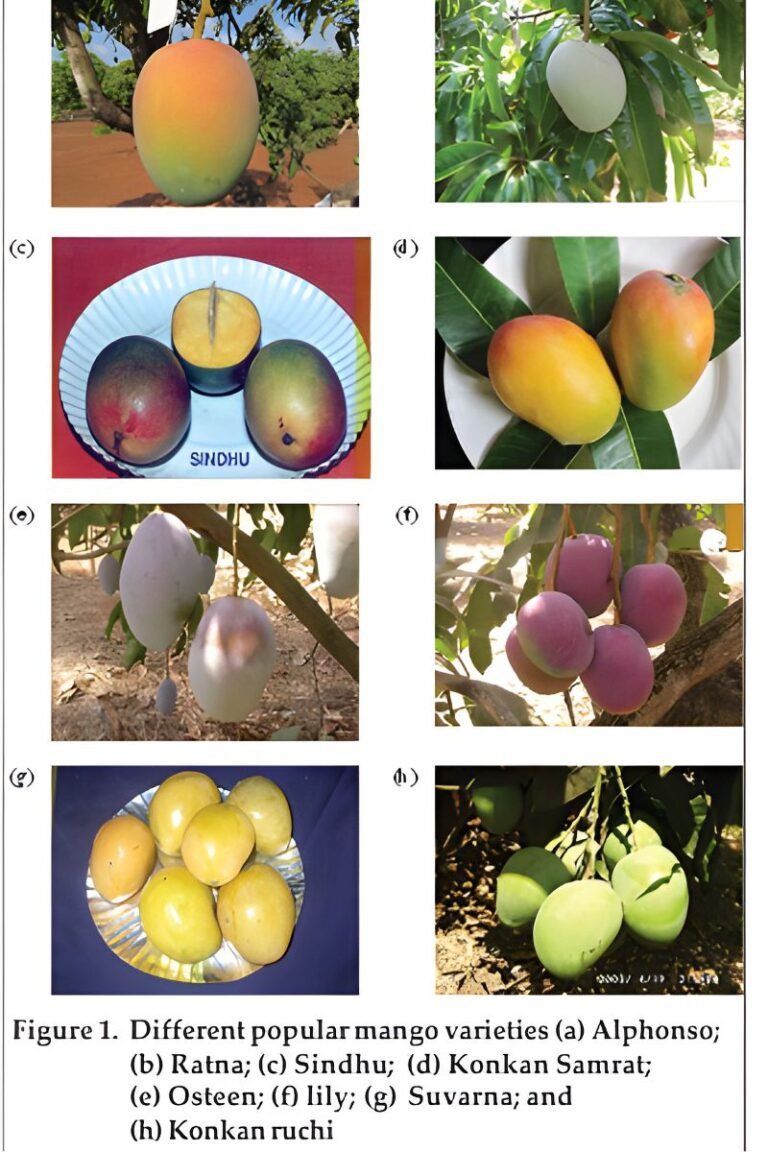
There are other reasons also for embracing the hard rock mango cultivation practice. With the horticultural revolution in Konkan region post 1990, all the suitable land for mango with specified depth was occupied immediately. This prompted some farmers to explore the possibility of planting mango on hard-rock by adopting the technique to make these hard surfaces suitable for mango cultivation. Their age-old observations of early flowering and production of good quality mangoes of Alphonso trees planted in the natural cracks on rocky areas helped them to enter into this novel technique. Advanced mechanization of drilling, blasting and excavation of pits in hard rocks played an important role in the spread of this approach. Rough estimates indicate that nearly 3 lakh hectares of such hard rock area is fallow in Konkan, Maharashtra. Some success stories indicate that Alphonso trees grown on such type of land bear fruits early which are sold at a premium price in metros and abroad due to its characteristic taste and colour (Table 1). These areas have been reported to be in Sindhudurg district (about 30% of total area in Vengurle, Malvan and Deogad tehsils) and Ratnagiri district (10-15% of total area in Rajapur, Lanja, Ratnagiri, Guhagar, Dapoli and Mandangad tehsils) (Bhattacharyya et al, 2018).
The technique for layout and blasting for fracturing the rocky layer is widely used now throughout the Konkan. As the excavated material from the rocky areas after blasting is not suitable for mango trees, non-native good quality poyta (soft) soil from the adjoining areas is procured for filling the pits at the rate of approximately 1 brass per pit (Burondakar et al. 2013). The excavated material is used in situ for preparing a raised mound around the individual plant (Figures 5, 6 and 7). Nearly 20 to 25 thousand hectares of mango orchards have been raised in south Konkan in a 10 km wide strip along the coast starting from Mochemad in Vengurle (South Konkan) to Dabhol in Dapoli (Central Konkan) using this technique.
There are mixed experiences of the farmers in terms of failure and success of hard rock mango cultivation (Salvi et al. 2009). The success of this technology mainly depends on (i) type of rock (continuous hard, semi-hard or soft rock determining root penetration and water drainage), (ii) generation of cracks in the side-walls and bottom of the pit facilitating root spread, (iii) dimensions of the pit to occupy at least 75-100 cubic feet of soil, (iv) quantum and quality of soil used for refilling the pits, and (v) time and intensity of canopy management as per the planting density adopted. It has also been known that during blasting operations, the cracks in the underlying hard pan are not appropriate for easy penetration of water, and the trees may fail to survive to produce optimum yield. The reports have been made about death of trees if inappropriately planted in these areas due to severe heat in pit as high as 50 oC in the parts of the Western Ghats. This is in sharp contrast to the basic understanding that soil temperature in summer is always less than the above mean temperature in the tropics (concept of mean summer soil temperature of US Soil Taxonomy (Soil Survey Staff, 2014). In most of the cases these observations are based on conjectures.
Hard Rock Mango Planting: Reason for Success
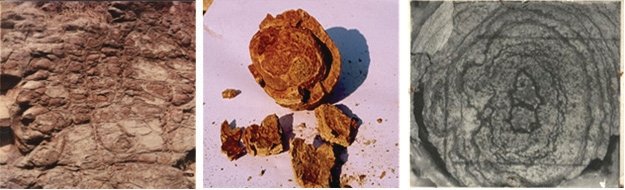
Primary laterite is a rock of sub-aerial formation of fine-grained and monogenous texture with the exception of iron content. It has been reported to form mainly in the Deccan plateau especially on the higher elevation of the Western Ghats with variable thickness of 50 to 90 ft in the southern Maharashtra including Mahabaleshwar. Most of the laterites found in the low lying coastal region on the east and west side of the Peninsula are termed as secondary laterites. Between Mumbai and Ratnagiri (and also now Sindhudurg), the appearance of secondary laterite is well pronounced and it extends down south to Goa separating the Western Ghats from the sea. Between Ratnagiri and Goa, the secondary laterite forms a kind of plateau with a general elevation of 200-300 ft amsl from the coast to the inland towards the Western Ghats. This laterite is also found on a higher elevation and it shows that it is conglomeratic (Pascoe, 1964). It is found at 35 ft in Ratnagiri and Sindhudurg which is less than the average. In the south of Malvan (South Konkan), the underlined rock is reported (as in other parts of the Deccan trap) of gneissic and metamorphic origin. The bulk of the laterite of India is reported near the Western Ghats and in the southern part of Maharashtra. Laterite is highly porous and when freshly queried it may be very soft and can be cut by a pick or a knife. It hardens when exposed to air due to desiccation of the argillaceous components resulting in the redistribution of ferric oxides.
The fresh pits prepared for planting Alphonso in Devgad (Sindhudurg district) are situated exactly near the sea coast (Figures 4 and 5). The samples collected from different depths from these pits were analyzed and the data are shown in Table 2. General observations made in these laterite areas suggest presence of cracks, relatively loose debris and mixture of red and black soils. These soils appear to nourish the mango trees naturally. This is notwithstanding with the fact that normal practice after excavation is to fill with soils (brought from other areas), the cow dung and superphosphate. Appropriate productive mechanism is also suggested to avoid termites in the form of mixing the soil with 100 g of Folidol (methyl parathion) (Salvi et al. 2009)
| Soil Samples | pH (water) | Sand (%) | Silt (%) | Clay (%) | Na | K | Ca | Mg | Cation Exchange Capacity (cmol(+) kg⁻¹) | Base Saturation (%) |
|---|---|---|---|---|---|---|---|---|---|---|
| 1 | 5.6 | 28 | 52 | 21 | 0.9 | 0.5 | 9.2 | 4.1 | 20.0 | 73 |
| 2 | 5.3 | 17 | 48 | 36 | 0.9 | 0.6 | 2.8 | 1.4 | 18.0 | 33 |
| Year | Yield Levels (t ha⁻¹) | Receipt Realized (Rs. ha⁻¹) |
|---|---|---|
| 5th year | 0.5 | 20,000 |
| 6th year | 1.0 | 40,000 |
| 7th year | 1.5 | 60,000 |
| 8th year | 2.0 | 80,000 |
| 9th year | 3.0 | 1,20,000 |
| 10th year | 4.0 | 1,60,000 |
| 11th year onwards | 5.0 | 2,00,000 |
| 12th year | 5.0 | 2,00,000 |
| Total | 8,80,000 |

It seems probable that after the initial drudgery of establishment in the hard rock aided by loose soil, manures and phosphorus, these trees receive consistent supply of nutrition from these zeolitized basalts. It has earlier been reported that these calcium-rich zeolites are present in the sand fractions to the tune of 2-3% (Bhattacharyya et al. 1999, 2006; Srivastava et al. 2002). It is quite probable that the hard basalts and their weathered counterparts (murram) should contain more zeolites to help in providing nutrition to the young mango plants. Earlier studies on mineralogical makeup of weathering rinds of basalt indicated presence of necessary stress may add to the overall success of
this practice.
Conclusion
Land resources are limited. So it is a technique which has been proved successful to bring premium price to the harvested mango fruits (Table 3). The success of this method is known and it is expected that this will further increase in years to come not only in Konkan but also in areas with similar landscape.
Author
Dr. D.S. Yadav/Mr. R.A. Sinha