

Artificial Ripening of Fruits Using Ethylene Gas
This Guidance Note has been prepared by Ms. Ruby Mishra, Technical Of icer at FSSAI. This note contains information collected and compiled by the author from various sources and does not have any force of law. FSSAI does not take any responsibility for any error and omission in this note.
SUMMARY
Fruits are best natural food for all and provide essential nutrients. The consumption of fruits has increased considerably in recent years due to awareness about their beneits and their availability round the year. Fruit trade involves transporting fruits to distant places. Highly perishable fruits such as mango, papaya, banana, etc. cannot be stored and transported to long distances after ripening as they tend to spoil. Therefore, to avoid spoilage of fruit during transportation, traders generally harvest raw fruits and ripen them arti icially at the destination market before sale. Considering the importance of arti icial ripening in supply chain of certain fruits, Food Safety & Standards Authority of India (FSSAI) permitted the use of ethylene gas for arti icial ripening of fruits. Ethylene gas can be generated from various sources. Due to high cost and scarce availability of ethylene gas, traders often use unsafe and banned ripeners like carbide gas which can be potentially harmful to our health. The purpose of this guidance note is to create awareness among food business operators/traders, consumers and food safety of icials related to different aspects of arti icial ripening of fruits. It also includes Standard Operating Procedures (SOP) detailing all facets of arti icial ripening of fruits using ethylene gas and its reliable sources.
A. Introduction
Fruit ripening is a combination of physiological, biochemical, and molecular processes which lead to changes in colour, sugar content, acidity, texture, and aroma. In general, it is a physiological process which makes the fruit edible, palatable and nutritious. Fruits are classified into two categories according to the ripening pattern:
A: These fruits are usually harvested once they have reached its full maturity and can be further ripened during transit or storage. These include banana, guava, avocado, mango, apple, pears, apricots, peach, tomato etc.
B: Climacteric fruits Non-climacteric fruits: These fruits do not ripen after harvest. Thus, in order to attain full ripeness and lavour, these fruits are often harvested once they have fully matured and ripened in the orchard. It includes fruits such as lemons, orange, grape, cherry, pineapple, strawberry etc.
B. Need for artificial ripening
Artificial ripening is the process by which ripening is controlled to achieve desired characteristics intended for better consumer acceptance and improving sales.It is generally done for climacteric fruits such as mango, papaya, banana, etc. to achieve faster and uniform ripening characteristics. Globally, arti icially ripened fruits are considered as safe for human consumption if done using safe ripening agents. It facilitates the transportation of fruits like mango, banana, etc. which become soft and perishable after ripening. These fruits are transported to distant places in unripe condition to avoid loss and are arti icially ripened at the destination market before sale.
C. Provisions for artificial ripening of fruits under food safety & standards regulations, 2011
Artificial ripening of fruits by acetylene gas, commonly known as carbide gas is prohibited as per the provision in sub regulation 2.3.5 of Food Safety and Standards (Prohibition and Restrictions on Sales) Regulation, 2011. It permits the use of ethylene gas at a concentration up to 100 ppm (100µl/L) depending upon the crop, variety and maturity for artificial ripening of fruits.
D. Issues in artificial ripening
The Industrial-grade calcium carbide, popularly known as “masala” is often used by some unscrupulous traders to release acetylene gas for arti icial ripening of fruits like mango, banana, papaya, etc. Calcium carbide contains traces of arsenic and phosphorus which is harmful for humans and may cause dizziness, frequent thirst, irritation, weakness, dif iculty in swallowing, vomiting, skin ulcer, etc. The acetylene gas released from calcium carbide is equally harmful for handlers. There are chances that calcium carbide may come in direct contact with fruits during application and leave residues of arsenic and phosphorus on fruits. Thus, use of this chemical for ripening of fruits is banned in India. Considering the issue of rampant use of banned calcium carbide and non-availability of alternative ripening agent, Food Safety & Standards Authority of India (FSSAI) permitted the use of ethylene gas for ripening of fruits in India vide notification dated 23.08.2016.
E. Artificial ripening using ethylene gas
Ethylene is a hormone naturally produced within the fruit and regulates fruit ripening by initiating and controlling a series of chemical and biochemical activities. The treatment of unripe fruits with ethylene gas triggers the natural ripening until the fruit itself starts producing ethylene in large quantities. A Standard Operating Procedures (SOP) detailing all aspects of artificial ripening of fruits by ethylene gas is developed by the Working Group constituted at FSSAI on the recommendation of Scientific Panel on Fruits & Vegetables and their Products (Including dried fruits and nuts, salt, spices and condiments). The Working Group consists of members from the Scientific Panel and experts from relevant research institutes.
F. Standard Operating Procedure
- Restrictions
- Any preparation containing calcium carbide or acetylene gas.
- Any source of ethylene gas coming in direct contact with fruits
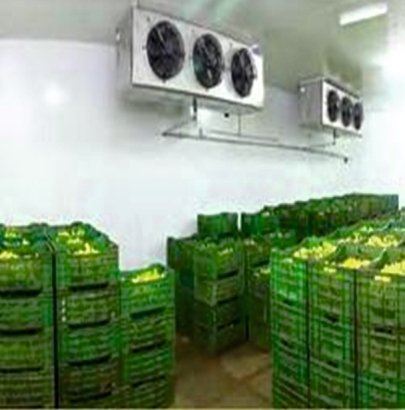
- Requirements for Ethylene Ripening System/Chamber
- Air tight room, preferably an insulated one for better temperature control
- Temperature regulation systems (cooling heating)
- Humidity regulation system
- Proper air circulation and ventilation
- Ethylene gas generation / injection system
- Ensured power supply (for ripening chambers)
- Display board indicating temperature, relative humidity, ethylene concentration, CO concentration.
3. Suggested handling conditions for stacking of fruits and air circulation Fruits should be kept in ventilated plastic crates or stackable fruit boxes inside the ripening chamber/temporary structure. Stacking of boxes should be done keeping minimum 4-6 inch space from the walls and between the adjacent crates. For uniform ripening, airlow throughout the chamber shall be maintained. Fruit should not occupy more than 75% of the volume of the chamber (as well as crate) during the treatment.
| Fruit | Ethylene exposure time (hours) | Ripening temperature (°C)* | Relative Humidity (RH) (%) |
|---|---|---|---|
| Banana | 24–48 | 15–18 | 90–95 |
| Mango | 24–48 | 20–22 | 90–95 |
| Papaya | 24–48 | 20–25 | 90–95 |
| Pear | 24–48 | 18–22 | 90–95 |
| Tomato | 24–48 | 18–20 | 90–95 |
4. Sources of Ethylene Gas:
Ethylene gas obtained through the following systems may be used for artificial ripening of fruits:
- a) For Ripening Chambers
- Ethylene gas cylinders
- Compressed ethylene gas (aerosol cans)
- Ethylene generators
- 2 chloroethylphosphonic acid (Ethephon/Ethrel) with alkali
- b) For Cartons/Boxes
- 2 chloroethylphosphonic acid (Ethephon) in powdered form
- Ethylene gas encapsulated in biologically safe ingredients such as cellulose, starch, and proteins

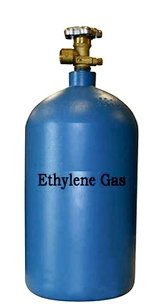


- Protocol for application of Ethylene gas from various sources
(i) Ethylene gas cylinders:
- Maintain the temperature and RH inside the empty ripening chamber as per Table 1, depending upon the commodity.
- Once desired temperature and RH is achieved, place the crates containing fruits into the ripening chamber. Temperature of fruits should be as close as possible to the temperature mentioned in Table 1, above.
- Introduce ethylene gas into the chamber (up to 100 ppm) through the gas cylinders.
- Monitor CO₂ inside the chamber and maintain it below 5000 ppm.
- Maintain the temperature, RH, concentration of ethylene gas and CO₂ levels as suggested above for 24–48 hours.
(ii) Compressed ethylene gas (aerosol cans):
- All items as in 5(i) above except (c).
- Instead of introducing ethylene through the gas cylinders, spray of compressed ethylene gas inside the ripening chamber (2.7 litres gas per can for 27 m³ volume or in the same ratio) shall be used, which results in maximum ethylene concentration of 100 ppm.
- Ethylene gas should be sprayed in the empty/open space in the chamber, not directly on the fruits.
(i) Ethylene generators:
- All items as in 5(i) above except (c).
- In this method, ethylene gas is generated using a catalytic converter from ethanol and is brought into the ripening chamber through a calibrated gas regulator (up to 100 ppm).
(ii) 2 Chloroethylphosphonic acid (Ethephon 39% SL) with alkali:
- All items as in 5(i) above except (c).
- In this method, ethylene gas is generated from 2 chloroethylphosphonic acid (ethephon 39% SL).
0.50 g is added in 2 ml of ethephon 39% SL for every 1 m³ air-tight room / ripening chamber.
Gas formation will start immediately. The maximum concentration of ethylene gas generated will be 100 ppm.
(iii) Sachet containing 2 chloroethylphosphonic acid (Ethephon) in powder form:
Ethephon in powder form may be used for artificial ripening of fruits. It shall be packed in 40–60 micron cellulose membrane paper or its equivalent in the form of small sachets. The ripening mixture in the sachets should be as per the composition recommended below. This ripening method may be used where ripening chambers are not available or for in-transit ripening. The sachet must generate ethylene gas only and should not contain any traces of calcium carbide or acetylene gas.
Composition:
2 chloroethylphosphonic acid (Ethephon), and a combination of alkali (oxides and carbonates of magnesium and calcium, sodium and potassium carbonates and bicarbonates, magnesium silicates).
- Keep the fruit in air-tight boxes or make the boxes air-tight using paper, etc.
- Take ethylene-forming sachet (500 mg containing 50 mg 2 chloroethylphosphonic acid – Ethephon) and dip it in water for 5–10 seconds.
- Place the water-soaked sachet in a perforated plastic box (approximately 5 cm × 5 cm × 5 cm in size).
- Place this small plastic box containing the sachet into the fruit box/crate (approximately at the centre of the box/crate) having a volume of 2.7 m³, which should be sufficient for 10 kg fruits. The ethylene gas generated will not exceed 100 ppm.
- Remove the small plastic box containing the sachet after 24 hours.
G. For food business operators / traders
a. Pre-treatment operations:
- Harvest the fruits at optimum maturity.
- Treatment with ethylene up to 100 ppm concentration should be used for ripening. The concentration of ethylene may go up due to autocatalytic production of ethylene once ripening is triggered by exogenous application of ethylene.
- Procure ethylene cylinder / aerosol cans / Ethephon / Ethefron from reputed companies.
- Ensure authenticity / purity of the sachet containing ethephon in powder form and other components.
- Use well-labelled sachets mentioning details of manufacturer, composition, instructions for use, etc.
- Ethylene releasing agents shall not come in direct contact with fruits.
- For uniform ripening in chambers, airflow throughout the room shall be maintained. Fruit should not occupy more than 75% of the volume of the chamber (as well as crate) during the treatment.
- Relative humidity, temperature, and exposure time shall be maintained as prescribed in Table 1 during ripening for best results.
- CO₂ concentration shall be maintained below 5000 ppm. It can be achieved by CO₂ scrubbing devices or air exchange at intervals of every 6 hours. High concentration of CO₂ will retard the ripening process.
- Post-treatment operations:
- Transfer the fruits to a ventilated room with appropriate storage temperature and relative humidity for ripening after completion of the treatment.
- Remove the sachet out of the fruit boxes after completion of the treatment (24 hours).
- Guidelines for safety:
- Ethylene gas is highly inflammable. Cylinders should be used with caution.
- Ethylene concentrations above 27,000 ppm are explosive.
- Smoking should be strictly prohibited around the premises.
- Electrical circuits should be properly monitored.
- Gas leakage monitoring system should be installed in commercial ripening chambers.
H. For consumers
- Purchase fruits and vegetables from known sellers / reputed stores / dealers who claim that fruits are not ripened by using harmful or banned chemicals.
- Wash fruits thoroughly with running potable water before eating.
- Avoid fruits with black blotches on the skin as these fruits are likely to be ripened by acetylene gas produced from calcium carbide.
- For Food Safety Officials
- The illegal use of calcium carbide in fruit markets / mandis and shops shall be monitored.
- Safety and purity of sources used for generating ethylene gas shall be monitored and regulated. Any source of ethylene gas should not come in direct contact with fruits.
- Labelling on ethylene releasing sources must be checked for composition, name of manufacturers, instructions for use, etc.
I. For Food Safety Officials
- The illegal use of calcium carbide in fruit markets / mandis and shops shall be monitored.
- Safety and purity of sources used for generating ethylene gas shall be monitored and regulated. Any source of ethylene gas should not come in direct contact with fruits.
- Labelling on ethylene releasing sources must be checked for composition, name of manufacturers, instructions for use, etc.
- Suspected samples of any source of ethylene gas shall be analysed for absence of calcium carbide by the authorized labs.
- The display units, if available in the ripening chambers, may be checked for concentration of ethylene gas used.
- Capacity building of fruit traders / FBOs may be encouraged for permitted source of ethylene gas and its use as ripening agent as per the standard operating procedure mentioned in section (F) of this document.
- The fruit traders need to be made aware of the danger of unsafe ripening agents such as calcium carbide.
J. Guidelines for natural ripening
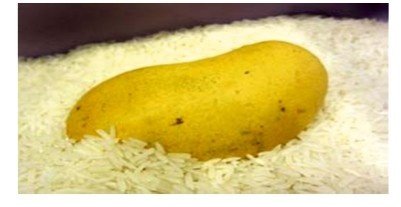
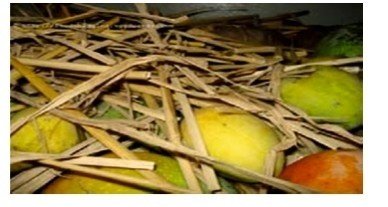
Fruits may be ripened naturally using the below mentioned methods within 4–6 days, if kept at room temperature. These methods entrap ethylene around fruit and facilitate faster ripening.
- Harvest the fruits at optimum maturity.
- Wrap the fruits individually with paper or place them in a paper bag.
- Keep unripe fruits in layers over paddy husk or wheat straw.
- Keep unripe fruits inside an air-tight rice bin / container.
Author
Ms. Ruby Mishra