

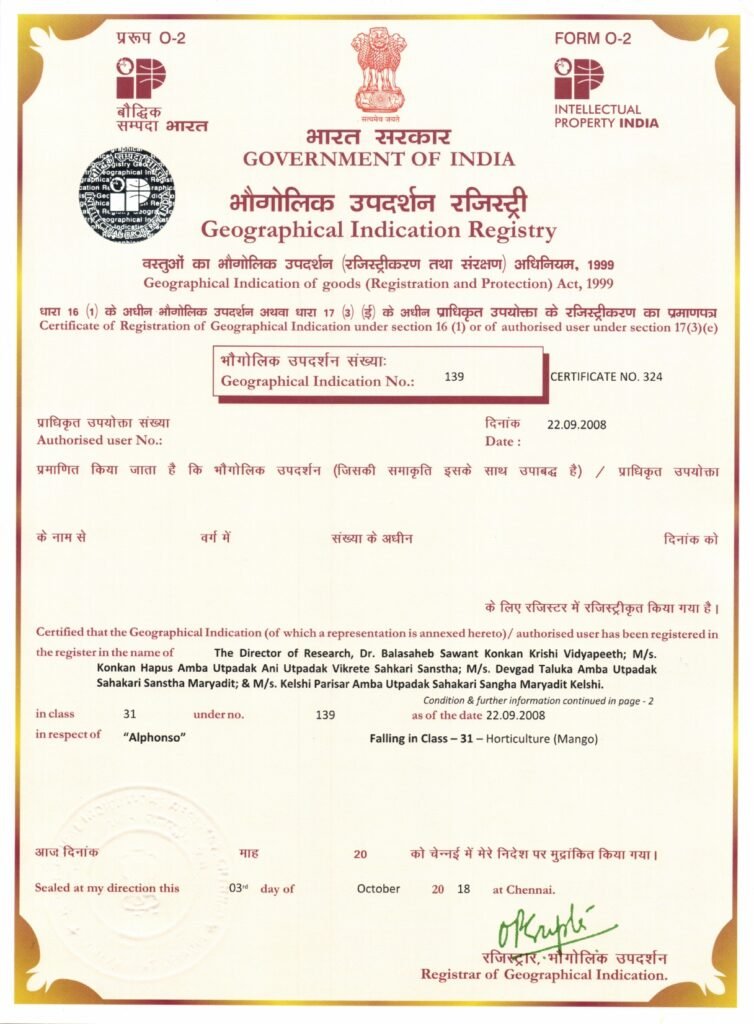
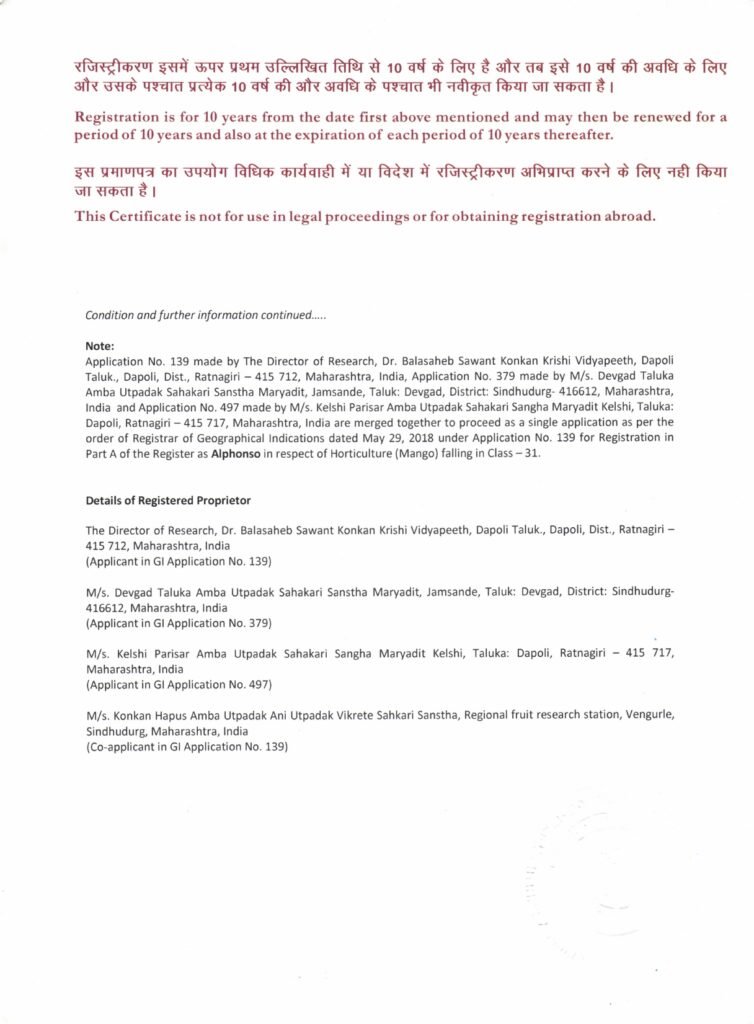
Geographical Indication of Alphonso Mangoes
ALPHONSO MANGO
It is a variety of mango grown in the region of some districts in Gujarat, Konkan region of Maharashtra, North Karnataka and the State of Goa.
The colour of the fruit is attractive orange yellow, the pulp is firm but melting, fibreless, texture is soft, flavour pleasant and the taste is very sweet.
Its skin is thick and green in colour before ripening. After ripening, the skin changes to thin and orange yellow in colour. It has an attractive blush towards the basal end. The colour of the fruit is attractive orange yellow. The pulp is firm but melting, fibreless, texture soft, flavour pleasant and taste very sweet.
Additional Details
(1) Tree
Height of atleast 9.3 m and average spread of 9.7 m (upon attaining 30 years).
The tree is moderately vigorous, trunk is medium, shoot thick, leaves are medium size and intermediate.
(2) Inflorescence
Inflorescence is broadly pyramidal with yellowish colour of main axis and rachis. The percentage of bisexual flowers in inflorescence is low.
(3) Flowering
Flowering is in 3 (three) flushes. First flush comes in last week of October – November with 15–20% crop. Second flush comes in November end to December with 35–40% crop and the third flush comes in January second fortnight to February which gives rise to maximum fruit set and yield.
(4) Fruiting
The tree starts fruiting at the age of 5 (five) years. The fruit gets matured and ready for harvest in 110–120 days. Fruits borne are in single or cluster.
(5) Fruit
Medium to big, 250–300 gms, oblong oval, stalk inserted obliquely, base obliquely flattened, cavity shallow, shoulders prominent and unequal, ventral rising and then rounded, dorsal ending in a long curve, sinus almost absent, round back of fruit without beak, apex broadly pointed. Skin very thick, yellow green, dots very few, medium and not prominent. Flesh attractive orange yellow, firm but melting, texture fine, fibre absent, flavour pleasant, taste very sweet.
(6) Root
The root system consists of a long, vigorous tap root and abundant surface roots.
(7) Stem
Growth of stem is upright and branching of stem is from 1–1.5 m height from ground level. For the purpose of measuring, the girth of stem and age of the tree is calculated. Average girth of the stem is 1.0 m – 1.8 m depending on age of tree (1.3 m is the girth of a 35 year old tree).
(8) Branching
Type of branching is indeterminate.
(9) Leaf
Shape of leaf is oblong lanceolate. The leaves are spirally arranged and produced in flushes.
(10) Seed
It is solitary (mono-embryonic), flat, ovate oblong, in a large woody stone, having excellent quality. It is surrounded by the fibrous endocarp at maturity.
(11) Fruit Quality
Fruit quality is of large, fleshy drupe, containing edible mesocarp of varying thickness. It is resinous and highly arable with respect to shape and size. Chlorophyll, carotenes, anthocyanins are present in the fruit, although chlorophyll disappears during ripening, whereas anthocyanin and carotenoid increase with maturity.
(12) Colour
Attractive yellow with slight reddish blush at the shoulder.
(13) Stone
Small to medium, oblong oval, fibre-absent, medium coarse with veins on surface.
(14) Lenticel
Harvesting starts from March end to onset of monsoon.
Basic Characteristics of Alphonso Mango
| Quality Criteria | Alphonso Mango |
|---|---|
| TSS (°B) | 19 |
| Acidity (%) | 0.34 |
| Ascorbic mg / 100 g | 62.15 |
| β-carotene µg / 100 g | 16,785 µg / 100 g |
| Non-Reducing Sugar | 8.19 % |
| Reducing Sugar | 5.79 % |
| Vitamin C | 32.7 mg / 100 g |
Table: Nutritional Value of Alphonso Mango
(Nutritional value per 100 g (3.5 oz))
| Nutrient | Value (per 100 g) | % Value |
|---|---|---|
| Energy | 70 kcal (270 kJ) | — |
| Carbohydrates | 17.00 g | — |
| Sugar | 14.8 g | — |
| Dietary Fibre | 1.8 g | — |
| Total Lipid (Fat) | 0.27 g | — |
| Protein | 0.51 g | — |
| Vitamin A equiv. | 38 µg | 4% |
| β Carotene | 445 µg | 4% |
| Thiamin (Vit B1) | 0.058 mg | 4% |
| Riboflavin (Vit B2) | 0.057 mg | 4% |
| Niacin (Vit B3) | 0.584 mg | 4% |
| Pantothenic Acid (B5) | 0.160 mg | 3% |
| Vitamin B6 | 0.134 mg | 10% |
| Folate (Vit B9) | 14 µg | 4% |
| Vitamin C | 27.7 mg | 46% |
| Calcium | 10 mg | 1% |
| Iron | 0.13 mg | 1% |
| Magnesium | 9 mg | 2% |
| Phosphorus | 11 mg | 2% |
| Potassium | 156 mg | 3% |
| Zinc | 0.04 mg | 0% |
GEOGRAPHICAL AREA
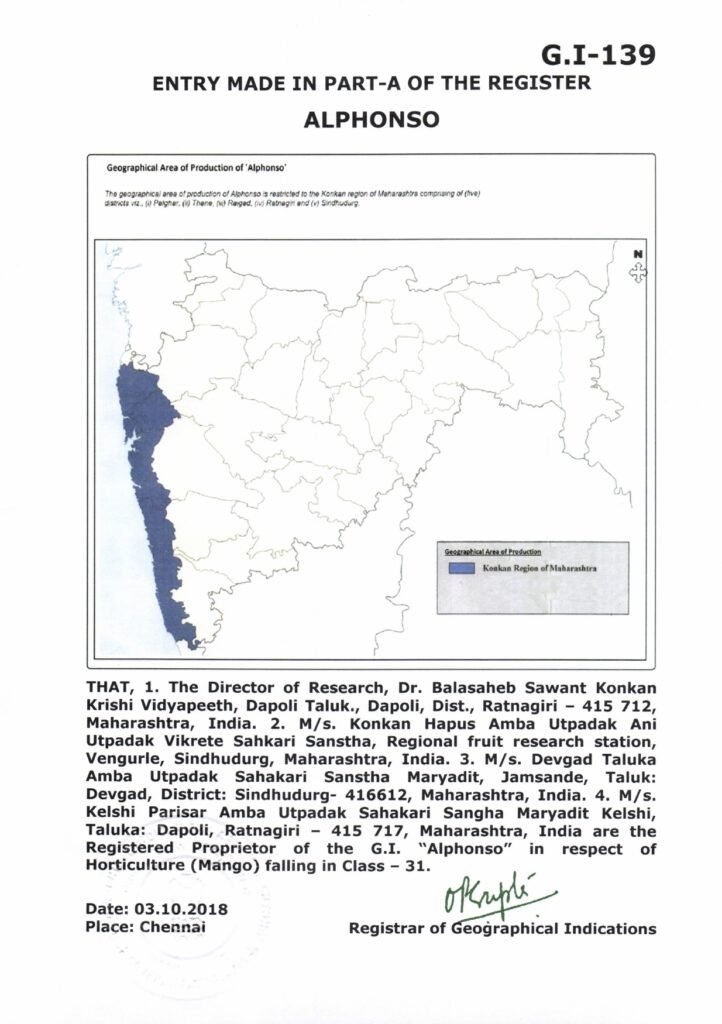
The geographical area consists of the western coastline of India. This includes some districts of Gujarat viz., Balsar, Vadodara and Bhavnagar. The Konkan region i.e., rugged coastal region of Maharashtra and North Karnataka, stretching from Raigad (in Maharashtra) to Mangalore and the state of Goa.
In 1961, the Konkan region became a part of the newly formed state of Maharashtra. Prior to this, it was a part of Bombay province which was split to form Gujarat and Maharashtra.
The geographical characteristics of this region is the narrow, hilly terrain strip of the Sahyadri ranges in the East and Arabian Sea in the West. This region comprises of following districts in various states:
Maharashtra State: 5 (five) districts viz., Mumbai, Thane, Raigad, Ratnagiri and Sindhudurg.
North Karnataka: 3 (three) districts viz., Uttar Kannada, Udupi and Dakshina Kannada.
Gujarat: 3 (three) districts viz., Balsar, Vadodara and Bhavnagar.
Goa: 2 (two) districts viz., Pernem and Madgaon.
The soils are mainly lateritic and medium black.
Based on agro–climatic variations, the Konkan region in Maharashtra is broadly divided into 2 (two) zones viz., South Konkan Coastal Zone and North Konkan Coastal Zone.
The South zone comprises of Ratnagiri and Sindhudurg districts, whereas, the North zone includes Raigad and Thane districts.
The Konkan region is distinguished from rest of Maharashtra State by virtue of its distinct agro-climatic conditions, soil types, topography, location, crops, cropping pattern, land holdings and socio–economic conditions of the farmers.
Although, Konkan region is traditionally famous as homeland for the commercial cultivation of world famous Alphonso Mango and cashewnut as rainfed crops, the area under these crops is presently around 35,000 ha. The other commercial crops grown in this area are coconut, arecanut and sapota.
At present, Alphonso Mango is mainly concentrated in Ratnagiri and Sindhudurg district, while a few pockets are found under cultivation in Raigad and Thane district of Konkan region.
While the agro–climatic characteristics of North Karnataka, Gujarat and Goa are as follows.
In North Karnataka, there is dry and humid climatic condition with medium rainfall (1500–2000 mm), while Coastal lines belts of Goa and Gujarat having Alphonso belts, is blessed with hot and humid climate and heavy rainfall ranging 3000–4000 mm (during June–September).
Brief description of the GI Area
Location
Geographical Position:
Portions of Gujarat, Konkan Region in Maharashtra State and North Karnataka and State of Goa.
Latitude
Gujarat:
Balsar – 20° 36′ N
Bhavnagar – 21° 44′ 57”
Vadodara – 22° 18′ 11”
Maharashtra State:
Mumbai – 18° 56′ N
Thane – 18° 20′ to 20° N
Raigad – 18° 12′ to 18° 80′ N
Ratnagiri – 16° 30′ to 18° 04′ N
Sindhudurg – 15.37° to 16.40° N
North Karnataka:
Uttar Kannada – 13° 55′ to 15° 31′
Udupi – 13° 20′ 60 N
Dakshina Kannada – 12° 57′ to 13° 50′ N
Longitude
Goa
Pernem – 15° 43′ 12” N
Madgaon – 15° 16′ 47” N
Gujarat
Balsar – 72° 59′ E
Bhavnagar – 72° 08′ 41”
Vadodara – 73° 11′ 40”
Maharashtra State
Mumbai – 72° 45′ to 73° 48′ E
Raigad – 72° 51′ to 73° 40′ E
Ratnagiri – 73° 02′ to 73° 52′ E
Sindhudurg – 73° 19′ to 74° 13′
North Karnataka
Uttar Kannada – 74° 9′ to 75° 10′ E
Udupi – 74° 45′ 06”
Dakshina Kannada – 74° to 75° 50′ E
Goa
Pernem – 73° 47′ 59” E
Madgaon – 73° 50′ 23” E
Altitude
150 to 550 meters above MSL
Annual Rainfall (during June – September)
North Karnataka: 1500 – 2000 mm
Goa and Gujarat: 3000 – 4000 mm
Temperature
Summer: 23°C to 35°C
Winter: 16°C to 25°C
Languages Spoken
Gujarati, Marathi, Konkani, English and Hindi
Communities Settled
Hindu, Muslim, Christians, Jains and others
Agricultural Cultivation
Fruit crops: Mango, Cashew, Sapota, Kokum, Karonda, Jamun and Jackfruit
Plantation crops: Coconut, Arecanut and Spices
Field crops: Rice
Districts
Maharashtra State: Mumbai, Thane, Raigad, Ratnagiri, Sindhudurg
North Karnataka State: Uttar Kannada, Udupi and Dakshina Kannada
Gujarat: Balsar, Vadodara and Bhavnagar
Goa: Pernem and Madgaon
District Boundaries
North: Rajasthan State
West: Arabian Sea
South: Southern Karnataka State
East: Sahyadri Mountain Range (Western Ghat)
Origins of Alphonso Mango
The name ‘Alphonso’ can be traced almost 400 (four) hundred years back to a Portuguese noble man, Afonso De Albuquerque. He introduced this exquisite and expensive variety of mango by bringing them on his journeys to Goa. Further detailed, ‘Alphonso’ in Konkan which was pronounced as ‘Hapoos’ in Maharashtra. Thereafter, it spread to the coastal tract of Maharashtra particularly to Konkan region.
Alphonso – As a Variety
Alphonso, the most delicious variety of mango, is known for its excellent texture, taste, aroma, early bearing and keeping quality.
The botanical name of Alphonso Mango is Mangifera indica L.
This delicious and juicy mango with pleasant flavour and fragrance has long been one of the world’s most popular fruits and grows the finest mangoes in the world and although more than a thousand varieties exist, the Alphonso is considered the best. The luscious fruit is loved for its wonderful colour, wholesome fragrance and irresistible taste.
Accordingly, the Alphonso Mango is nicknamed as “King of Mangoes.”
Plantations of Alphonso Mango in the Konkan region is being presently cultivated on an area of about 1,64,000 hectares in the Konkan region, more than 95% of the area is under production of a single variety viz., Alphonso Mango.
However, this variety bears yield on alternate years and the productivity in general is very low (2.5 t/ha) due to irregular and alternate bearing habit of the tree.
Exports
This variety accounts for nearly 60% of the mango export trade from India.
Export data for the last 5 (five) years indicated that export of Alphonso Mango from India has boosted to Rs. 63.05 Crores. This is likely to by the year 2010 to the extent of Rs. 100 Crores of foreign exchange for India.
An additional Rs. 45 – 50 Crores of foreign exchange is also expected from the export of processed mango products.
Method of Production
(1) Cultivation Process
Selection of site and soil: It should be nearest to seashore and well drained lateritic soil PH 6.5 to 7 is good for cultivation of Alphonso mango.
Pit size: 1 m × 1 m × 1 m size.
Filling of Pits: This is done in May month. Filling with 1 to 4 pots of FYM + 2 kgs SSP + 50 gms Carbaryl.
Plotting and Spacing: cleaning, spacing – normal 10 m × 10 m and high density 5 m × 5 m square planting system.
Planting: During start of monsoon in month of June.
Topography: Hilly areas / sloppy land and plain land too is best suited for plantation.
Irrigation: Irrigation with 150 to 200 litres of water per tree at the interval of 15–20 days from pea stage. Irrigation should be stopped one month prior to harvest. Irrigation is also managed in the following manner for first 3 (three) years after planting.
Age of Graft During Winter Season During Summer Season 1st Year Weekly 3 to 4 days interval 2nd Year Fortnightly Weekly 3rd Year Monthly Fortnightly Fertiliser requirement: Fertiliser management is done during the months of June and July right from the first year of growth of the tree by application of FYM, Urea, Super phosphate and Potash.
Pruning and Trimming: Pruning is done in the month of May or October by center opening. The system of pruning involves cutting of center branch at 15 feet height from ground level and cutting of overlapping branches. While pruning, branch should not split. Thereafter, bordocux paste is applied on cut portion of branches.
(2) Soil
It is best suited in well drained lateritic soil with PH 6.5 to 7.0.
It does not perform well in soils having PH beyond 7.5.(3) Agro – Climatic Conditions
It is best suited to hot and humid climate which prevails in western coastline of India. The following regions:
Konkan Region i.e., coastal region of Maharashtra and North Karnataka, stretching from Raigad (in Maharashtra) to Mangalore, some portions in Gujarat and the whole of Goa state.
(4) Climate
High rainfall ranging from 2000 to 4000 mm
Temperature range: max 27 – 37°C and min 13 – 23°C
Relative humidity range: 35% – 99%
Sunshine hours: about 8 – 12 hrs
(5) Propagation
It is highly heterozygous and cross-pollinated crop. Epicotyl or Stone grafting is widely practiced in Konkan region of Maharashtra.
Epicotyl grafting: It is also known as stone grafting. In this method, the seeds of mango are sown in nursery bed and covered with 5 to 7 cms thick layer of farm yard manure. While sowing seed, preference is given to sand bed which provides ease in uprooting of seedling required at the time of grafting.
In about 15 to 20 days, seeds start germination. The germinated seedlings of 7 to 10 days age, when its leaves remain copper in colour, is used for grafting. The seedling is deheaded at a height of 10 cms from ground level. A vertical slit of 2.5 to 3 cms length is given on deheaded portion of rootstock.
Scion shoot of 2 to 3 months age having pencil thickness is used. The leaves of scion is defoliated 10 days before grafting to facilitate sprouting. After uniting rootstock and scion, it is wrapped using polythene tape of 300 gauge. The grafted plant is then maintained in other bed or pots in nursery.
This method of grafting is practiced during June–July during which the environment remains sufficiently moist.
(6) Required Nutrients
21 (twenty one) nutrients are required for the growth of plants which include mainly:
N (Nitrogen)
P (Phosphorus)
K (Potassium)
Ca (Calcium)
S (Sulphur)
Mg (Magnesium)
These are the major nutrients. Fruits remove these nutrients in various quantities.
Studies showed that 1 (one) ton Alphonso remove nutrients as detail below:
| Sl. No. | Nutrient | Quantity (kg) |
|---|---|---|
| 1 | N | 0.270 |
| 2 | P | 0.660 |
| 3 | K | 9.880 |
| 4 | Ca | 2.620 |
| 5 | Mg | 2.000 |
| 6 | S | 1.710 |
| 7 | Fe | 0.270 |
| 8 | Mn | 0.290 |
| 9 | Zn | 0.021 |
| 10 | Cu | 0.022 |
(7) Management of Pests / Diseases
Enclosed in the Annexure of various diseases and pests that attack different parts of the Alphonso Mango tree and its schedule of management.
(8) Bearing Age
The tree starts bearing in its fifth year of age.
The fruit starts maturing in 110 to 120 days.
The season is March to May and harvesting is over before the onset of Monsoon.
(9) Yield:
150 to 250 fruits per tree.
(10) Harvesting:
• Stage of Maturity
The fruit is harvested when it is at a maturity stage of 85%. At this stage, the following changes occur:
The colour of the fruit changes from dark green to yellowish green.
It bulges at the shoulder leading to depression at peduncle.
The beak of the fruit changes from pointed to blunt.
Oily glands develop on the fruit surface.
• Method of Harvesting
The fruit is harvested by a mango harvester.
At this stage, the fruit has a pedicel length measuring 4–5 cm.
The harvested fruits are to be kept under shade.
Minimum handling of the harvested fruit should be followed.
• Post Harvest Management
A. Sorting
It is done according to weight.
Spotted fruits are first removed.
The fruits are then dipped in 2.5% salt solution. The good quality fruits normally float and these are taken out for export purpose. The balance fruits are affected with “spongy tissue.”
The harvested fruits are dipped in 0.1% carbendazim solution for 5 minutes to avoid spoilage.
B. Grading and Standards
The fruits are graded according to their weight in the following manner:
Grade A – 250 to 300 gms
Grade B – 225 to 250 gms
Grade C – 200 to 225 gms
Grade D – 175 to 200 gms
(11) Packaging
• Waxing
Alphonso fruit when dipped in 1.7 to 2.7% aqueous emulsion of fungicidal wax containing O-phenyl phenol lessened the physiological loss in weight and increased the storage life of the fruits reported. The fresh Alphonso fruits treated with 6% wax emulsion recorded the lowest percentage of spoilage as compared to control fungicide (thiabendazole) alone. Another fruit coating, marked as “Vapour Gard”, is an antitranspirant. The effect of coating the fruit in a 3% solution was to reduce water loss and retard ripening.
• Pre-cooling
Methods adopted to pre-cool the fruits
The primary ones are:
Air cooling – This is done by placing the fruits into a cool room.
Hydro cooling – This is done by either dipping the fruits in cold water or effective spraying of cool water.
Vacuum cooling – This is done by reducing atmospheric pressure which reduces the pressure of water vapour in the chamber.
Pre-cooling of mango to 12 – 15°C with 500 ppm Bavistin increases the shelf life. In case of Alphonso variety, it also reduces the incidence of spongy tissue. Significant reduction in respiration rate, slow rate of ripening and good surface colour of fruit in mango were achieved by hydro cooling coupled with Bavistin.
• Packing
Packing of Alphonso mangoes is done in wooden boxes for the distant market and corrugated boxes are used for export purpose.
• Domestic Transport / Shipping for Exports
Domestic Transport: Transport in un-refrigerated carriers is done during evening and night only to avoid the incidence of spongy tissue as temperature is low during night hours.
Sea exports: It is transported under refrigerated conditions, wherein the respective vessel is having entire refrigerated decks filled with pallets. In case of sea containers, CA is linked to central ducted refrigerated container vessels. Alternatively, integral containers with their own individual cooling systems or integral controlled atmosphere (CA) containers may be used.
• Uniqueness
The distinctiveness or uniqueness of Alphonso Mango lies in the following:
The tree has early bearing.
The size of the fruit is uniform and large-medium sized, weighing about 250 gms.
It has an attractive yellow colour with slight red blush towards the stalk end.
The shoulder of the fruit is prominent with round back of fruit without beak.
The pulp is firm, fibreless with excellent orange colour.
It has good sugar-acid blend and a pleasing flavour.
It has a longer shelf life, i.e., its keeping quality is good for about 21 (twenty one) days.
It is best suitable for fruit processing activities, i.e., for making into pulp, powder, leather and ‘khawa’.
Dr. BALASAHEB SAWANT KONKAN KRISHI VIDYAPEETH (BSKKV)
BSKKV is having its headquarters situated in Dapoli, Ratnagiri district in Maharashtra.
It was earlier referred to as Konkan Krishi Vidyapeeth (as per Konkan Krishi Vidyapeeth Act, 1972), which was established as an independent Agriculture University on 18th May, 1972 for the overall development of Konkan region by the Maharashtra Government, comprising the area of five (5) districts of Konkan region, viz., Mumbai, Thane, Raigad, Ratnagiri and Sindhudurg districts of Maharashtra.
The said Act was further amended as “Maharashtra Agriculture University Act 1983”, as a common Act for four (4) Agriculture Universities in Maharashtra. Thereafter, Konkan Krishi Vidyapeeth was renamed as “Dr. Balasaheb Sawant Konkan Krishi Vidyapeeth, Dapoli” w.e.f. 12.02.2001.
BSKKV is presently in jurisdiction of five (5) districts of Maharashtra, viz., Bhiwandi-Mumbai, Thane, Raigad, Ratnagiri and Sindhudurg districts of Maharashtra.
The major objective of the University is agricultural education, research and extension education in an integrated way to attain sustainable agricultural development of Konkan region.
Regional Fruit Research Station, Vengurla
Regional Fruit Research Station at Vengurla in Sindhudurg District of Maharashtra was established in 1957. This Research Station has done a lot of research on Alphonso Mango. It has also standardized its cultivation practices like pit size, spacing, planting system, grafting technology, irrigation and fertilisers requirement, training and pruning.
Author
Zaheda Mulla